
The CBSE board exams for Class 10 and 12 are already here. Every year, lakhs of students sit for these exams, and the stakes feel real because they are. Whether you’re in Class 10 or Class 12, you probably know someone who’s stressed about these boards right now. The pressure is there, sure – but so is the opportunity to prove what you’re capable of.
You’ve got a few weeks left. That’s enough time to make a real difference, but only if you study smart. Not just hard – smart. That’s what this guide is about.
Why You Need a Study Plan?
Here’s something I’ve noticed teaching for years: two students study for the same number of hours and get completely different results. One gets a 95, the other gets a 65. Same time invested. Same textbooks. Different outcomes.
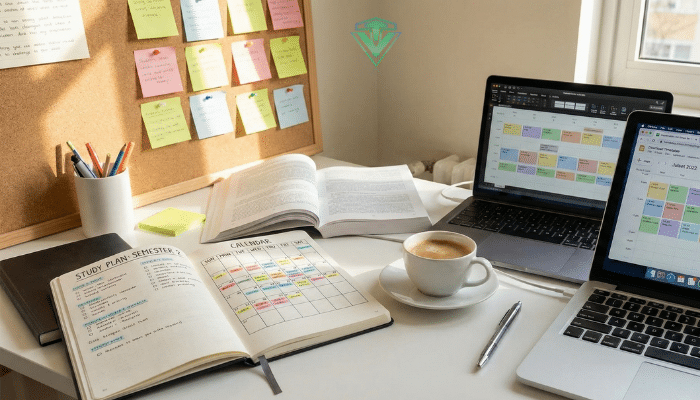
Why? Because one student *knew what to study and when*, and the other was just hoping things would work out.
A good study plan does three things:
- Removes the guesswork – You’re not wondering “Should I study this chapter or that one?” You know your priorities.
- Reduces the panic – When you have a roadmap, exam season feels less suffocating.
- Your brain actually remembers things – Studying the same concept multiple times, spaced over weeks, sticks. Random cramming doesn’t.
The numbers back this up: students who follow a structured plan typically score 15-20% higher. That could be the difference between 75 and 90.
Know What You’re Up Against: The Actual Exam Pattern
Before you open a single textbook, spend an hour understanding the exam itself. Seriously.
What Class 10 Students Face
- 3 hours per paper – Not much time to show everything you know
- Subjects: Hindi, English, Maths, Science, Social Studies, plus whatever optional subject you’ve taken
- Marks breakdown: 80 marks from the exam, 20 from internal assessment
- Question types: Multiple choice, short answers, long answers – all mixed together
- The reality: Not all chapters carry the same marks. Some chapters are worth 10 marks, others just 2 or 3.
What Class 12 Students Are Dealing With
- 3 hours per paper again – Time pressure is real
- Subjects: English, Maths or Applied Maths, Physics, Chemistry, Biology or IT, plus optionals
- Marks: 80 from exam, 20 from internal (the internals really matter here)
- Question types: MCQ, 2-4 mark short answers, 5-6 mark long answers
- Important shift: CBSE has moved away from “just memorize and vomit it back.” They want to see if you can apply what you’ve learned.
This matters because your study approach should match what they’re testing. If they’re asking application-based questions, rote learning won’t cut it.
Your 2-Month Study Plan
Two months sounds short, but if you use it right, it’s solid time. Here’s how to break it up:
Weeks 1-3: Just Get Through Everything
- Go through all your textbooks, one chapter a week
- Don’t aim for perfection here – just coverage
- Make notes that you’ll actually understand when you re-read them
- If something feels weak, make a note of it. You’ll come back to it.
- Aim to cover one subject per day, then move to the next
Weeks 4-6: The Practice Weeks
- Stop just reading. Start doing
- Pick up previous years’ papers – CBSE papers from the last 5 years, at minimum
- Solve them, don’t just look at answers
- For Maths and Science: actually solve the numerical problems with pen and paper
- For English and humanities: write out your answers, not just think through them
- Time yourself. Get used to the exam clock
- This is where you’ll spot the gaps in your understanding
Weeks 7-8: Non-Stop Revision and Mocks
- Every other day, take a full-length mock test
- Go through your answers carefully – especially the ones you got wrong
- Identify patterns: Do you always mess up a certain type of question? A certain topic?
- Spend the rest of your study time fixing exactly those weak spots
- Do quick revisions of high-scoring chapters so you don’t forget them
- Light topics can get a quick once-over; don’t overdo it
Subject-by-Subject: What Actually Works
Mathematics – No Shortcuts Here
Maths can’t be crammed. You know this already. But here’s what can be done:
What to do:
- Give it 2-3 hours every single day. No exceptions.
- In the first three weeks, finish one chapter completely—solve every problem in the exercise
- Weeks 4-6: Practice, practice, practice. One problem set per sitting.
- Keep a notebook just for mistakes. When you get something wrong, write it down, redo it a week later, redo it again two weeks later
- Class 10 folks: Algebra is your bread and butter. Geometry and Trig come next. Master those three
- Class 12 folks: Calculus will show up everywhere. Know it cold. Same with vectors and probability
The honest truth about solving papers: Solve at least 10-15 full papers timed. Your speed comes from this repetition, not from some magic formula.
Science – Mix Theory and Problems
Science isn’t one thing. It’s three different animals.
If you’re doing Biology (the theory one):
- Diagrams matter more than you think. Draw them repeatedly—the process part (photosynthesis, digestion, etc.), the anatomical parts (plant and animal tissues, organs)
- Write answers in your own words, not copied from the textbook
- 90 minutes of focused study daily is enough
- One hour learning, 30 minutes writing practice
If you’re doing Physics and Chemistry (the number-heavy ones):
- Follow the Maths playbook: practice a lot, understand before memorizing
- Learn the formulas, yes, but know why they work
- Spend 90 minutes per subject daily
- At least half of that time should be spent solving numerical problems, not reading theory
- Keep a formula sheet and a derivation sheet—especially for Class 12
The connecting piece: CBSE loves asking questions that mix topics. A Maths + Physics question, or Biology + Chemistry. Your brain should start seeing these connections naturally. When you’re studying reproduction in Biology, think about the evolutionary advantage. When you’re doing thermodynamics in Physics, think about how it applies to the Earth’s climate.
English – It’s Not About Perfect Grammar
English worries a lot of students, but here’s the thing: it’s not about being perfect.
Reading section (comprehension, etc.):
- Read one unseen passage daily – takes 15 minutes
- After reading, summarize it in 2-3 lines in your own words
- Your vocabulary matters, so learn 10 new words every few days
- When you’re reading, don’t just see the words – understand what the author is saying
Writing section (essays, letters, reports):
- Write twice a week. Full essays, 500-600 words each
- Don’t just think through them. Sit down and actually write
- Show what you’ve written to a teacher, a senior, anyone who can give you feedback
- Grammar and spelling matter, but flow and clarity matter more
Literature section (poems, plays, prose):
- Read the textbook lessons thoroughly, but don’t try to memorize everything
- For each story or poem, know: Who are the main characters? What happens? What’s the author trying to say?
- Write short character sketches – this forces you to understand, not just memorize
- Practice writing short-answer questions, because that’s what they’ll ask
Optional Subjects – Don’t Treat Them as Secondary
Your optional subject (History, Geography, Economics, Accounts, etc.) counts the same as everything else. Don’t ignore it just because it feels optional.
History and Geography need:
- Mind maps for big events and concepts
- Your own understanding of why things happened, not just dates
- Geography? Learn the maps. Actually draw maps when you’re revising
- Timeline making helps a lot
Economics and Accounts:
- Practice problems
- Understand the concepts behind the problems
- Can’t just memorize answers
The Revision Method That Actually Works: Space It Out
Here’s the reality: you study something today, and by next month you’ve forgotten most of it. That’s not laziness – that’s your brain.
But here’s the trick: if you revisit that same information at the right times, it sticks.
The Weekly Cycle That Works:
- Day 1: You study something new and make notes
- Day 2: Spend 5 minutes re-reading those notes (just the notes, not the textbook)
- Day 4: Spend 10 minutes going back to that topic plus the previous day’s topic
- Day 7: Spend 20 minutes revising everything from that week
- The next week: Quick 5-minute look before you move on
This isn’t magic, and it’s not new—teachers have known about this for years. But it works. Your brain locks the information in properly instead of forgetting it.
Mock Tests: Your Best Practice Ground
Real talk: mock tests aren’t fun. But they’re the single best thing you can do to prepare.
Why they matter:
- You see the actual pattern – No surprises on exam day
- Speed practice – You learn how to manage 3 hours
- Confidence – Each test you take, you get a little less nervous
- Reality check – Mock tests show you exactly what you don’t know yet
How often should you take them:
- First 2 weeks: One mock per subject, untimed (just to see the questions)
- Weeks 3-4: One full-length, timed mock per subject
- Last 4 weeks: Two full mocks per subject every week
After every single mock test:
- Check your answers. Understand why you got things wrong, not just that you got them wrong
- Calculate your score and track it – watch the improvement over weeks
- Look for patterns – do you always mess up a certain question type? A certain topic?
- Fix it. If you’re weak in a specific area, study that before the next mock
Mistakes Everyone Makes (And How to Avoid Them)
After years of teaching, here are the things I see students do that mess up their boards:
1. Studying 10 hours straight without a break: Your brain doesn’t work that way. Study 45 minutes, take a 10-minute break. That’s it.
2. Ignoring past papers: CBSE repeats question patterns. Past papers are like cheat codes. Use them.
3. Treating all chapters equally: Your syllabus isn’t flat. Some chapters have way more marks than others. Prioritize.
4. Staying outside the syllabus: You’ll see interesting topics online, in YouTube videos, everywhere. Stick to the official CBSE syllabus. Don’t waste time.
5. Pure memorization: “I memorized the entire science textbook and still failed.” Heard that? You need to understand, not just memorize.
6. Ignoring internal assessments: 20-30 marks are just sitting there, waiting for you to pick them up. Projects, practicals, assignments – take them seriously.
7. Changing your study method every week: Stick with a plan for 2-3 weeks before deciding it’s not working. Give strategies time to work.
8. Sleeping 5 hours and eating junk food: I know the pressure is on, but your body and brain need sleep and nutrition. 7-8 hours of sleep will help you score more than 2 extra hours of studying.
How Vector Tutorials Can Help
I can give you all the advice, but at some point you need someone to actually teach you—to answer your doubts, to check your work, to tell you honestly where you’re weak.
That’s what Vector Tutorials does.
Our team of teachers knows the CBSE inside and out because we’ve been teaching it for years. Here’s what you get:
✅ Physical and Online Classes – For every chapter, explained by actual teachers (not just reading from the textbook)
✅ Doubt sessions – Ask a question, get an answer within hours (not days)
✅ Full mock tests – With detailed solutions and analysis
✅ One-on-one guidance – If you’re really stuck on something
✅ Focused revision notes – Just the important stuff, not 50 pages of fluff
Hundreds of students have improved their scores significantly using Vector Tutorials. Not because we’re miracle workers, but because good teaching + consistent study = results.
Book Free Demo Class – Vector Tutorials Tuition Center in Alwar.
Board exams are tough, but they’re not impossible. Every year, lakhs of students clear them, score well, and move on to the next phase.
The difference between a student who scores 65 and one who scores 90 isn’t talent. It’s usually planning, consistency, and knowing where to focus.
You’ve got this. You really do. Start today, stick with your plan for the full 8 weeks, and I promise the results will show.
All the best! 🚀